What if the people closest to the work know something you don’t?
When a safety requirement is not followed, the reason may not be what leaders assume. Louise Wheal explores what Learning Teams can reveal about how work gets done in practice.


When a safety requirement is not followed, the reason may not be what leaders assume. Louise Wheal explores what Learning Teams can reveal about how work gets done in practice.
Louise Wheal, Principal Consultant with JMJ, explores how Learning Teams help leaders understand the reality of how work gets done, creating opportunities for better decisions, stronger engagement and safer outcomes.
As leaders, we invest a huge amount of time and energy in making work safe. We develop procedures, carry out risk assessments, provide training and put controls in place. Understandably, we expect people to follow them.
So, what happens when they don’t?
It can be tempting to conclude that the problem lies with the individual. Perhaps they need more training. Maybe expectations haven’t been communicated clearly enough. Or perhaps we need to reinforce the importance of following the rules.
But what if we asked a different question?
Throughout my consulting career, I have seen how easily a gap can develop between how senior managers believe work happens and the reality experienced by the people doing it.
No procedure can account for every eventuality. Conditions change. Equipment doesn’t always behave as expected. Priorities compete. People encounter situations that weren’t anticipated when the procedure was written. They use their judgment and adapt to keep the work moving safely.
Most of the time, those adaptations are successful, which is precisely why they can remain invisible. A day without an incident does not necessarily mean that all the conditions for safe work are in place. People may have been successfully navigating weaknesses in the system that managers simply don’t see.
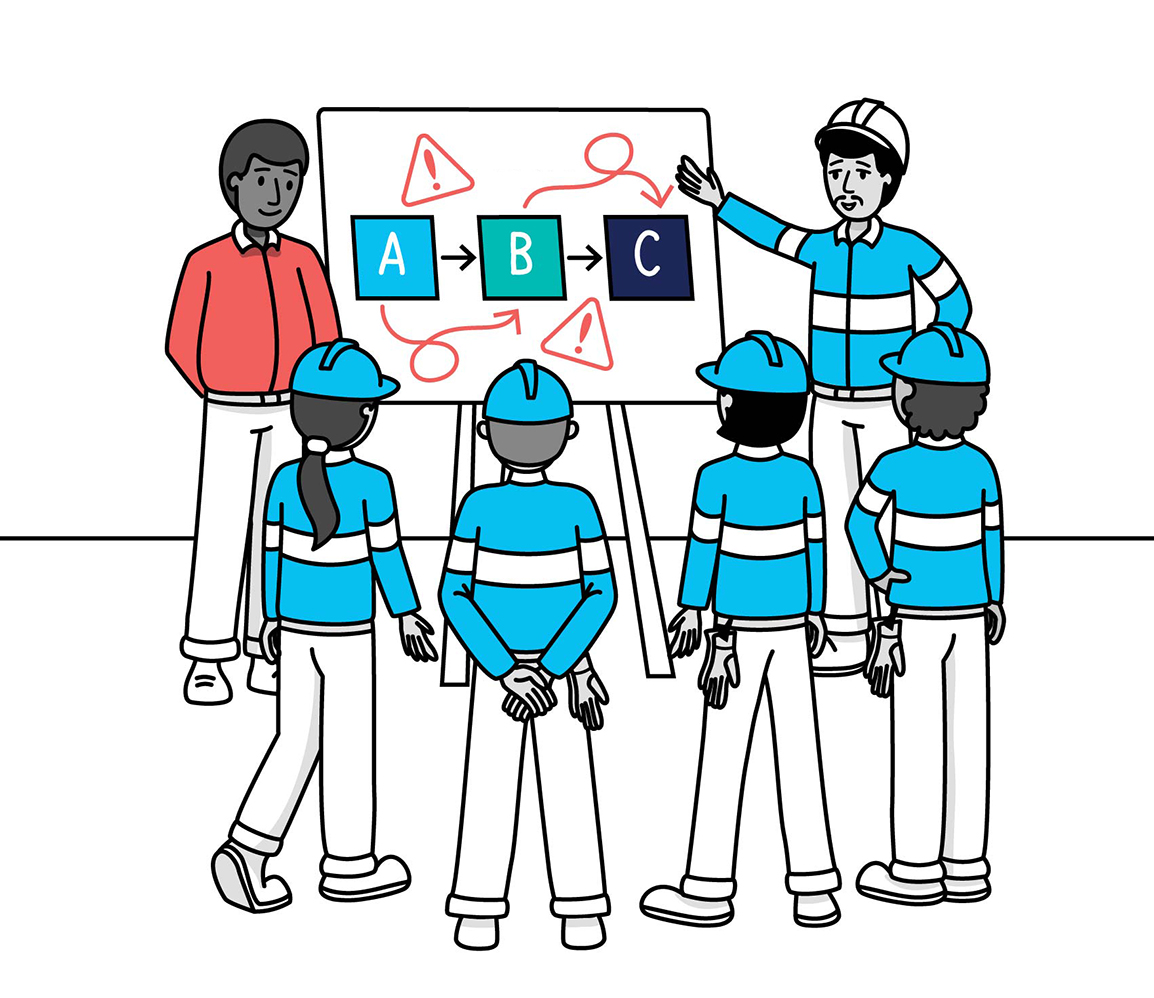
Learning Teams are structured, facilitated conversations with the people who know the work best. Their purpose is not to investigate an individual or search for a single root cause. They help us understand what supports safe, successful work, what gets in the way, what pressures and constraints people experience, and where the system could be improved.
For me, one of the most important shifts is from compliance to curiosity.
Instead of asking: Why didn’t they follow the procedure?
We might ask: What was happening that made this action make sense to the person at the time?
It doesn’t mean procedures or accountability no longer matter. It means recognizing that behavior happens in context. Meaningful accountability begins with understanding the context, not simply correcting the action we see.
When we focus solely on correcting behavior, we risk missing the conditions that shaped it and the opportunity to make the work safer.
I saw a simple but powerful example of this on a construction project.
An operating team carrying out a particular task was regularly observed without the required safety glasses. Several attempts had been made to change their behavior, but nothing seemed to make a difference.
From the outside, it looked like a straightforward compliance issue.
Rather than telling the team again what they should be doing, the facilitators brought them together in a Learning Team and listened to their experience of the task.
They learned that the eye protection provided was misting up. From the operators’ perspective, wearing it impaired their vision and introduced another risk while doing the work.
Once the context was understood, the operators helped identify suitable anti-mist eyewear. A different specification was sourced, and people could wear the required protection without compromising their ability to see the task clearly.
The conversation also had a wider effect. The team members subsequently began sharing concerns about other aspects of their work, providing greater insight into risks that might otherwise have remained hidden.
Until someone became curious enough to ask, the organization was trying to solve the wrong issue.
Learning Teams can be particularly valuable when organizations experience recurring incidents, equipment failures, near misses or situations where procedures aren’t producing the expected results.
But there is an equally important opportunity: learning from when things go right.
Every day, people successfully navigate complex working environments. They make judgments, solve problems and adapt to changing conditions.
What are they doing that enables that success?
There may be informal practices, conversations between colleagues or small adjustments that aren’t captured in a procedure. The people doing the work know what helps the job go well, what makes it challenging, and what could make the task safer.
Putting people in a room and asking questions doesn’t guarantee learning.
People need to believe they can speak honestly about the reality of their work without being blamed or punished for what they reveal. Leaders and Learning Team facilitators need to ask thoughtful questions, listen with intent and create an environment in which people feel safe to speak openly.
And then leaders need to act on what they learn.
The people closest to the work should have a voice in identifying potential improvements and experimenting with solutions that make sense in their working environment. That’s when Learning Teams become more than a safety technique. They start to build an organization’s capacity to learn.
For leaders, this requires humility.
We need to be willing to accept that a system we designed may not work exactly as intended; that a procedure that makes perfect sense on paper may be difficult to apply in practice; and that the people closest to the work may see things that we cannot.
So, the next time you encounter a recurring safety issue, a procedure people seem reluctant to follow, or simply a piece of work that consistently goes well, consider starting with a different question:
Who does this work every day, and what can they teach us?
The answer might change how you understand the situation and what you choose to do next.
Change starts here. Let’s talk about how JMJ can help solve your safety and performance challenges.